Wheels, Blades, and Belonging: How Adaptive Fencing Found a Home in Houston
Walk into a fencing gym and the first thing you notice is noise. Sneakers squeaking, blades clacking, a coach yelling about distance. Now picture that same gym with the sneakers silent — and everything else exactly the same. That is the picture adaptive fencing is painting across Houston right now, one Tuesday night at a time.
Strip Away the Footwork and the Sport Is Still There
From the outside, fencing looks like a legs sport. Lunge, retreat, bounce, repeat. But footwork is the delivery system, not the product. The product is blade work, distance, timing, and the small psychological chess match that happens in the half-second before someone commits. None of that requires working legs.
That is the quiet insight behind adaptive fencing, and it is why the sport translates to athletes with physical disabilities far more cleanly than most people assume. You are not building a watered-down version of fencing. You are fencing.
Two Ways the Sport Adapts
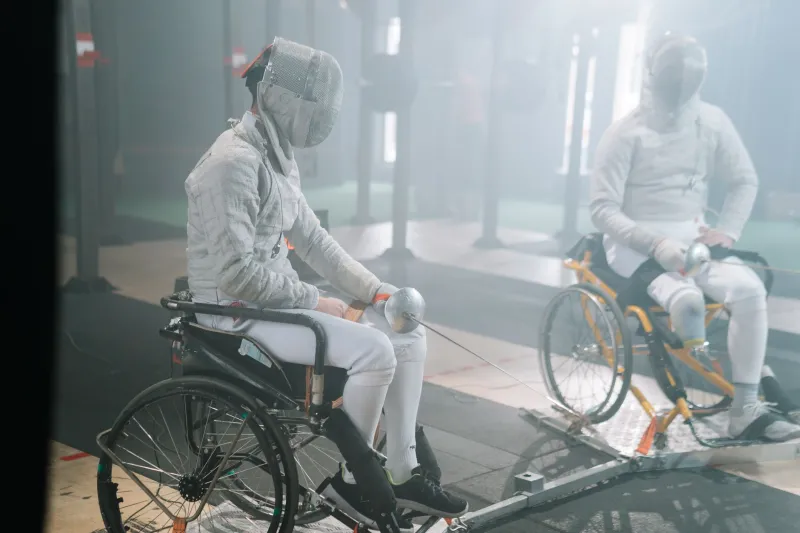
Wheelchair fencing is the most established pathway. Athletes with spinal cord injuries, lower-limb amputations, and other mobility conditions fence from wheelchairs that are clamped into a metal frame bolted to the floor. The two chairs sit at a fixed distance, so a fencer with shorter reach cannot simply be run away from. Nobody advances, nobody retreats. Everything happens from the waist up, and the action is often faster and more tactical than stand-up fencing because there is no escape hatch.
All three weapons — foil, épée, and saber — are contested in wheelchair fencing, and athletes are grouped into sport classes (A, B, and C) so that impairment levels are matched. It has been a Paralympic sport since the 1960 Rome Games, which surprises a lot of people who assume it is a recent invention.
Ambulatory adaptations cover everyone else: athletes with limb differences, cerebral palsy, joint conditions, balance disorders, or fatigue-driven conditions. Here the adjustments are more individual — shortened footwork patterns, seated blade drills, one-handed repetitions, extra rest built into a lesson, grip and cuff modifications, a prosthetic fitted with a specific cuff for weapon control. A coach who knows what they are doing changes the drill, not the standard.
The Coaches Doing the Work
Houston's fencing map is spread wide — the Heights, Katy, Clear Lake, Sugar Land, the Memorial corridor — and adaptive coaching has grown the way most things grow here: through individual coaches who got curious and then got trained.
Much of that training runs through USA Fencing's parafencing resources and through continuing education with rehabilitation professionals. Locally, a lot of families first hear about the sport from a physical therapist or recreational therapist, often connected to the Texas Medical Center network. That referral pipeline matters more than any marketing, because it reaches people who have already been told what they cannot do.
The practical bottleneck is equipment. A fixed fencing frame is not cheap and not small, which is why clubs share them, borrow them, and partner with each other rather than each buying their own. If you call a club and they do not have a frame, that does not mean the answer is no — it may mean they can point you to a club that does, or to a coach who runs ambulatory sessions in the meantime.
What a First Session Actually Feels Like
Less intimidating than you would guess. A good first session starts with a conversation, not a blade: what your mobility looks like day to day, whether you use a chair and what kind, any skin-integrity or fatigue considerations, whether you have a prosthetic and how it is fitted.
Then the warm-up, which for wheelchair fencers is seated and focused on shoulders, trunk rotation, and grip. Glove on. Mask on. Blade in hand. The first drill is almost always the same one every beginner in the world does: touch the coach's blade, then touch it again, then do it while the coach tries to stop you.
Nobody bouts on day one. Nobody gets hurt on day one. If a club throws you straight into a full-speed exchange on your first visit, that is a signal to keep looking.
For parents, the questions are practical: Is there step-free access to the gym floor? Where does the chair get stored between classes? Can a sibling fence in the same time block? Is the coach comfortable being asked these things without getting defensive?
First Steps, Without the Overthinking
Call before you register, and ask three specific questions: Does the club have access to a fixed frame or a coach with adaptive experience? Is the training space accessible from parking to piste? Can you try one class before committing to a session?
Expect the cost of an adaptive beginner class to look roughly like a standard beginner class — most clubs do not surcharge for it — with equipment provided early on and a personal mask and glove coming sooner than you think. Competition exists at the local level and at national parafencing events, but there is no clock running. Plenty of athletes train for a year before their first bout and are better fencers for it.
The piste is fourteen meters long for everybody. Blades do not check legs at the door. If you have been waiting for a sport that meets you where you are, this one has been quietly waiting back.