The Cross-Training Ladder: Six Houston Hobbies Ranked by What They Actually Do for Your Fencing

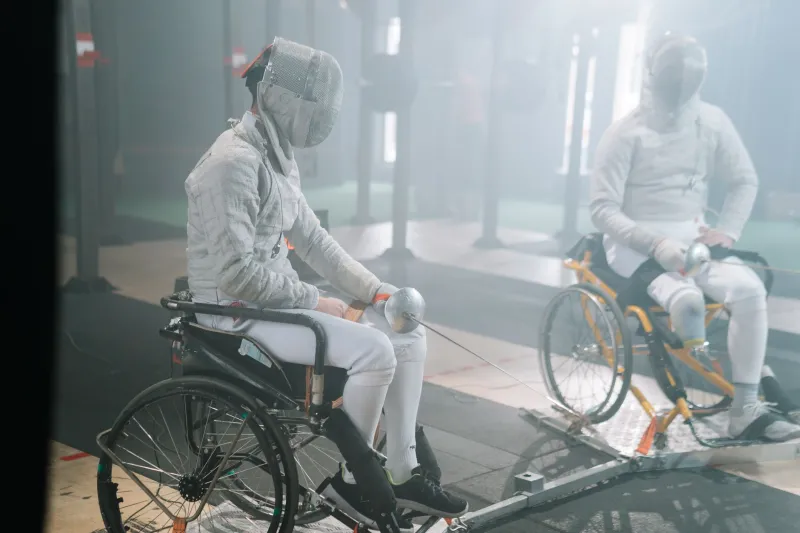
Photo: Rosiestep, CC BY-SA 4.0, via Wikimedia Commons
Every fencer eventually gets the same advice: cross-train. Then they walk into a big-box gym, do three sets of bench press, and wonder why their lunge still looks like a folding chair collapsing.
Here is the unwritten rule I use when judging any workout: does it ask me to move my body in a way fencing asks me to move my body, under some kind of time pressure? Fencing is lateral, rhythmic, stop-and-go, and reactive. It rewards the ability to change direction on a dime and to stay balanced while doing something stupid-fast with one arm.
Very little of what happens in a weight room checks that box. Quite a lot of what happens in Houston dance studios, climbing gyms, and lap pools does. So here is the ladder, ranked.
1. Salsa and Other Partner Dances
The best cross-training for fencing in this city is also the one that gets the most eye rolls. Partner dancing is weight transfer, rhythm, and reading another human's body for cues — which is, functionally, what a bout is. You learn to keep your hips under you while your upper body does something expressive. You learn to move on a beat without looking down at your feet. You learn that being slightly off-balance when your partner moves is a problem you have about a quarter-second to fix.
Houston has no shortage of studios doing salsa, bachata, and swing, and most run cheap beginner nights. Go for eight weeks. Your footwork will get quieter, and your ability to wait for the right moment — the single hardest skill in fencing — will improve in ways drills struggle to teach.
What it fixes: timing, weight transfer, rhythm under pressure, forward-backward subtlety.
2. Rock Climbing
Indoor climbing gyms have multiplied around the Heights, Montrose, and the Energy Corridor, and climbers make weirdly good fencers. Climbing teaches you to solve a problem with your body while tired, to trust a grip, and to keep your hips close to the wall — all of which map onto blade work and en-garde posture more directly than most people realize.
The contrarian caveat: climbing builds a lot of pulling strength, and fencing is a pushing sport. Do not let your shoulders turn into a slingshot that only works in one direction. Pair it with something that opens the chest and shoulders back up.
What it fixes: body awareness, grip strength, problem-solving under fatigue.
3. Swimming
Houston summers are a hostile act, and swimming is the cross-training that survives them. Lap pools at city rec centers and community centers are cheap, and an hour in the water builds the aerobic base that keeps your legs alive in the third period of a pool or a direct-elimination bracket.
The benefit is durability more than explosiveness. Fencing's shoulder demands are lopsided — one arm does the work of ten — and swimming balances the joint without pounding it. Just do not mistake a long, steady swim for piste conditioning. It is the foundation, not the house.
What it fixes: aerobic base, shoulder durability, heat-proof cardio.
4. Yoga
The least exciting entry and the one people quit first. Yoga's real gift to fencers is hip mobility and breath control — the ability to stay low in a deep en-garde without your lower back filing a complaint, and the ability to slow your heart rate between touches when you are down 4-2.
Where it fails: yoga does not build explosive anything. If yoga is your only cross-training, you will be flexible, calm, and slow. Use it as a supplement, ideally on recovery days.
What it fixes: hip and ankle mobility, breathing, recovery.
5. Pickup Soccer and Basketball
Underrated, mostly because adults stop playing them. Any sport that makes you read a moving opponent and cut laterally at speed is building the exact neuromuscular pattern a fencing retreat-and-attack lives on. The risk is ankles and knees, so be honest about your warm-up and pick the game with the least reckless human in it.
What it fixes: change of direction, reaction time, competitive nerve.
6. Distance Running — The Trap
Here is the contrarian part. Jogging is the most popular cross-training choice for fencers and one of the least useful. It builds aerobic capacity, which is fine, and almost nothing else that transfers. Fencing is lateral, interrupted, and anaerobic. A fencer who runs five miles three times a week can still be winded after a 90-second assault, because those are different energy systems and different movement planes entirely.
If you love running, keep running — the Memorial Park loop is not going anywhere. Just stop counting it as fencing training and add something that moves you sideways.
What Does Not Make the List at All
Heavy bench pressing, biceps curls, and most machine-based circuits. They build muscle that photos well and does nothing on the strip. Sprint intervals, agility ladders, and medicine-ball throws do more for your fencing than a full-body machine workout ever will, and they take twenty minutes.
Stacking It Into a Houston Week
A sane week: two or three fencing classes, one dance class, one swim or climb session, one mobility day. In July and August, everything moves indoors and everything starts before 9 a.m. or after 7 p.m. In January, when the air is briefly reasonable, move the cardio outside and enjoy it while it lasts.
The point is not to become a generalist athlete. The point is to build a body that can do something fast, weird, and precise at the exact moment it is asked to.